
eMpasys Nvoltaic is a division of eMpasys renewable technology engineering company. The division will focus on providing Nvoltaic renewable tech decentralized power systems, consultations and designs. The division will help bring to market, educate, promote and design various Nvoltaic possible solutions. The Nvoltaic renewable tech solutions can be integrate into various applications as a power source.
The Nvoltaic renewable technology solutions can be jointly developed into various power required applications.
The advanced energy storage renewable power technology is designed to provide 100% on demand power and will generate electricity without external input (e.g. Solar power, wind power, or any gas) it will produce economical sustainable clean energy. The scalable renewable technology solutions can be design for various power consumption requirements. Nvoltaic power output increases as the 22-layer G-Si stack increases. This is similar to a 30 layer micro-chip design.
(Zero Emission, Operates Silently, No Moving Parts, ).
Power Cube Standard Size Nvoltaic Power System Specs;
- Power Production: 6 – 7 kW
- Internal consumption: 1-2 kW
- Power output: 5- 6 kW
- Annually Production: 43,800 kWh
- Available voltages: AC 380 V – AC 220 V
- Dimensions: 31.5 x 15.8 x 23.7 inch
- Expected Life Span: 15yrs – 20yrs
- Weight: 111 lbs
- Production time line: 2027
This is a scalable renewable technology that can be designed for power back up or primary power. This solution can provide reliable power 24 Hrs a day, 7 Days a week regardless of the weather condition.
Commercial Industrial Example Below
Nvoltaic 24/12Kw Power Cell Converters Configuration (264Kw)
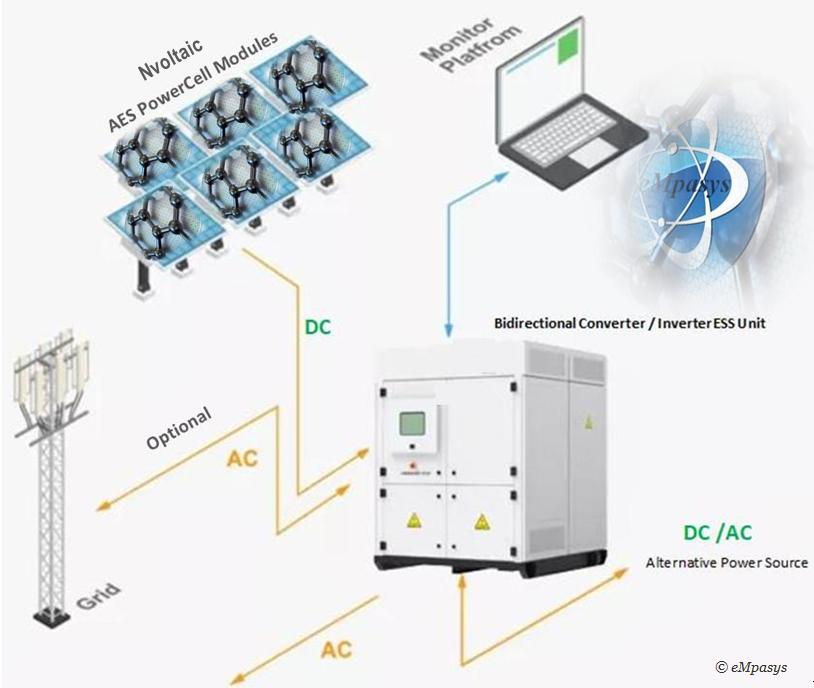
The technology will help reduce the burden on any centralized grid power resource. It will help mobilize decentralized EV charging infrastructure and it will provide optional off grid power resource for all.
As energy demand continues to increase our world’s centralized electrical power grids are experiencing tremendous and unsustainable strain. This strain leaves us vulnerable to electricity shortages, rolling blackouts and electricity quality issues. Making matters worse, a large number of the centralized power grids are inefficient and “dirty” – squandering precious natural resources.
Renewable tech energy storage comes in a variety of forms, including mechanical (e.g., pumped hydro), thermal (e.g., ice/water), and Electro Chemical (e.g., power cells, batteries and with the advancements in energy storage like Graphene, quantum computing, nanotechnology and advanced materials have overcome barriers preventing wide-scale deployments.
There is a difference between the terms “alternative energy” and “renewable energy.” Alternative energy refers to any form of energy that is an alternative to traditional fossil fuels, like oil, natural gas, and coal. Renewable and clean energy, on the other hand, refers to forms of energy that are renewed by mechanical or natural processes, such as magnetic wave energy, cosmic energy, solar energy, wind energy, hydropower and kinetic energy.
© eMpasys
Request Information:
Thank you for your response. ✨

© eMpasys
 eMpasys